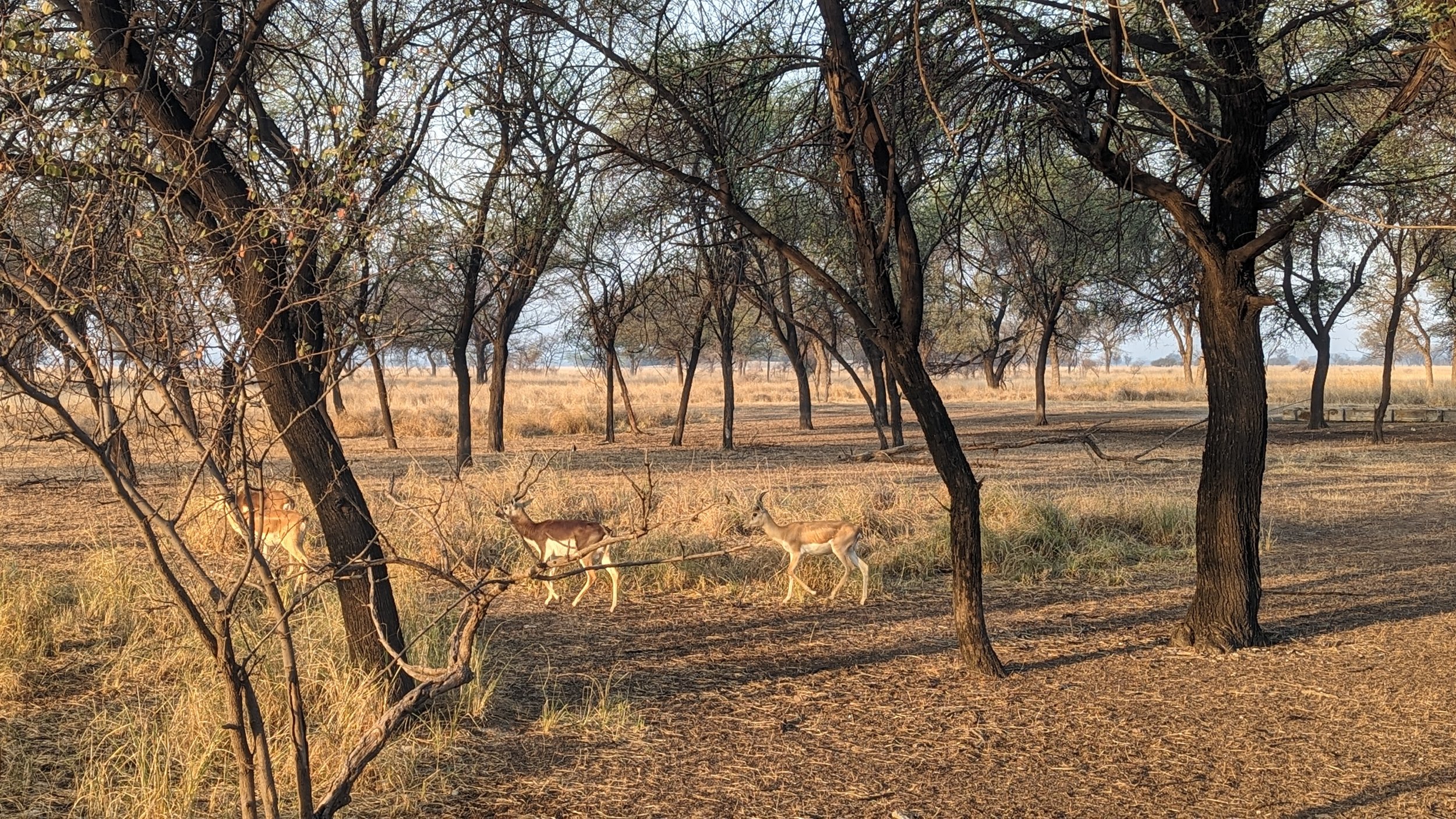
Tal Chhapar Sanctuary - Chhapar, India.
MELA: Mating Ecologoy of a Lek-breeding Antelope
Scroll ↓

Project MELA focuses on the mate-choice behavior of Blackbucks in a lek. As a co-PI, I work on deploying computer vision to quantify the social interactions between the males and the females using videos recorded with a fleet of UAVs or drones. We built a software pipeline track spatial locations of 200+ antelopes for up to 90 minutes. This method produces the high resolution data required to explore the collective behavior and decision making processes involved in the lekking behavior. We track movement of each antelope at the lekking arena with the aim of answering questions related to function, mechanism and ontogeny of the lekking behavior. We are also using satellite imagery to understand the annual modification in the structure of leks. A short overview of the project can be found here. The project is funded by Dept. of Ecology of Animal Societies at the Max Planck Institute of Animal Behavior (MPI-AB) and Center of the Advanced Studies of Collective Behavior (CASCB) at the University of Konstanz.
MELA: Science, Art and Community building.
We are building MELA as a long-term research project focusing on one of the most fundamental questions in biology i.e. mate selection. Along with mate choice, we will measure daily level activity changes for multiple years to monitor annual changes in behavior patterns of animals. In the process, we will build a generic AI platforms for tracking movements of a large group of animals in a large area using a fleet of commercial drones. This method will be shared with biologists, conservationists and forest management. MELA team also recognizes importance of community building. We will continue to collaborate with artists and organize art-science events to promote public education about wildlife and technology. We organize workshops and offer mentorship to young Indian students to build local capacity. Project MELA puts equal focus on knowledge production and knowledge dissemination. Our entire work process is captured in a small documentary “MELA” (20 minutes) and you can watch it on YouTube.
Team
The project is initiated by Dr. Hemal Naik, Dr. Vivek Hari Sridhar and Dr. Akanksha Rathore. We have trained 12 students as assistants in the project. Our team relies on expertise of the local forest department of Gujarat and Rajasthan. Finally, we work closely with local members of the community, especially the safari guides and support staff, at the field sites. Their observations and knowledge about the local wild animals adds a broader perspective to our work.